
How Much Hair Fall Is Normal in a Day? Decoding the Numbers in the Indian Context
Noticed a scary clump of hair in your drain or comb? Before hitting the panic button, let’s explore medical benchmarks, Indian environmental realities, and Ayurvedic wisdom.

Every morning when you run your fingers through your hair or clean out your shower drain after a thorough wash, seeing loose strands can trigger an immediate wave of anxiety. In a society where lush, healthy hair is deeply tied to confidence and vitality, hair fall is one of the most common wellness concerns. But before you start revamping your entire vanity cabinet or stressing over every single loose strand, let's look at the scientific and clinical reality: how much hair fall is actually normal?
01. The Golden Benchmark: 50 to 100 Strands a Day
Dermatologists and trichologists worldwide agree on a baseline standard: losing anywhere between 50 to 100 strands of hair per day is completely normal and healthy.
To understand why this happens, we have to look at the natural hair growth cycle, which consists of three primary phases:
1. Anagen Phase
Growth Phase (2–7 Years)
Roughly 85% to 90% of your scalp hair is actively growing at any given moment.
2. Catagen Phase
Transition Phase (2 Weeks)
Hair follicles shrink and detach from the blood supply as hair prepares to rest.
3. Telogen Phase
Resting & Shedding (1–4 Months)
The hair rests until gentle friction (combing, washing) pushes it out, making way for new growth.
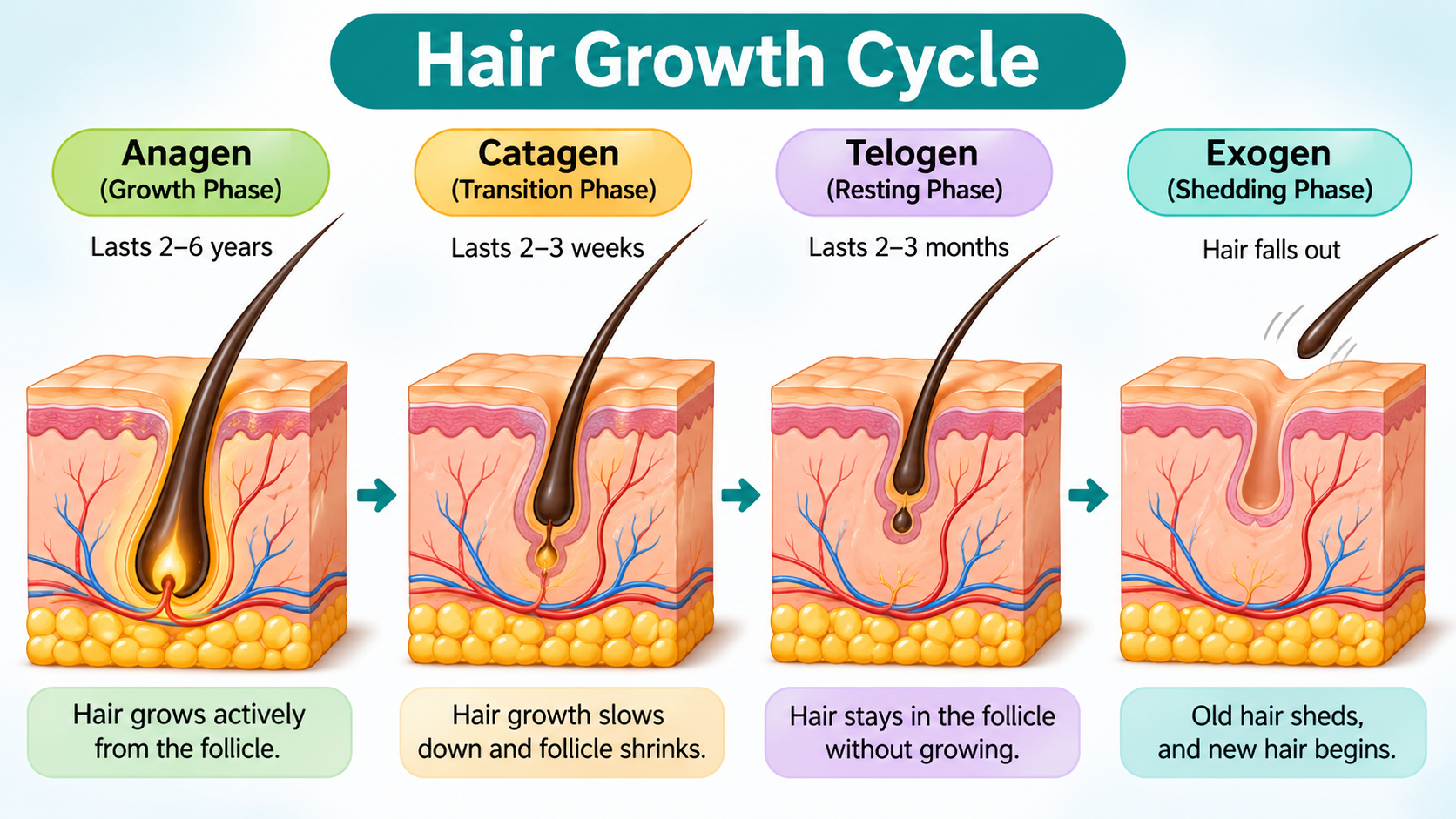
Understanding the hair growth cycle helps alleviate panic over normal daily shedding.
02. Wash Days vs. Non-Wash Days: Why the Math Matters
One of the biggest misconceptions Indian consumers have is assuming that a massive clump of hair in the shower drain after a hair wash equals premature balding. In reality, hair shedding is cumulative.
The Cumulative Hair Fall Equation
If you wash your hair every 3 days instead of daily, the hair that completed its resting cycle on Day 1 and Day 2 didn't fall to the floor—it remained trapped within your hair strands. When you finally lather and massage your scalp on Day 3, all 200–300 accumulated resting hairs are released at once.
Total over 3 days = ~300 hairs. This is mathematically normal, not sudden hair loss!
03. Benchmark Validation: When Combs and Drains Give False Alarms
Let's conduct a quick personal benchmark validation test. If you notice increased strands in your hairbrush or shower strainer, evaluate these key validation drivers before concluding you have alopecia:
The Pull Test Validation
Gently grasp a section of about 60 hairs between your thumb and index finger and pull lightly away from the scalp. If more than 6 hairs come away effortlessly every single time across multiple sections, you may be experiencing active shedding (telogen effluvium).
Bulb Check (Root Identification)
Look closely at the fallen strands. Do they have a tiny white or hard pale bulb at the tip? That means the hair completed its full life cycle and fell out naturally. If strands are breaking from the middle without roots, your issue is mechanical breakage, not biological hair fall.
04. Unique Indian Environmental & Lifestyle Triggers
Living in India presents distinct environmental challenges that can frequently push hair fall past the normal 100-strand baseline. Understanding these helps you isolate the root cause:
Hard Water Minerals
High calcium and magnesium content in municipal water across major Indian cities leaves mineral deposits on the scalp, causing dryness and brittle breakage.
Seasonal Monsoons & Humidity
Monsoon humidity increases fungal scalp issues (malassezia) and dandruff, leading to temporary seasonal telogen effluvium.
Nutritional Gaps (Iron & Vitamin D)
Subclinical iron deficiency anemia and widespread Vitamin D3 deficiencies in Indian urban demographics directly impact cellular follicle regeneration.
Urban Air Pollution
PM2.5 particulate matter and dust accumulation clog scalp pores and trigger oxidative stress on hair roots.
05. The Ayurvedic Perspective: Balancing Doshas
In traditional Indian Ayurveda, hair (known as Kesha) is considered a byproduct (mala) of bone tissue (Asthi dhatu). Hair fall is primarily viewed as an imbalance in the Pitta Dosha (fire and heat element) accumulating in the body due to stress, spicy foods, or irregular sleep cycles.
Cooling therapies like traditional warm oil massages (Shiro Abhyanga) with Bringraj, Amla, and Brahmi oils help pacify Pitta, nourish the scalp microcirculation, and anchor roots securely
06. When Should You Actually Worry?
If your daily shedding consistently crosses 150–200 strands, or if you notice distinct warning signs, it's time to consult a dermatologist or trichologist:
• Visible widening of the hair parting or thinning crown area.
• Circular patchy hair loss (Alopecia Areata).
• Scalp tenderness, severe itching, flaking, or burning sensations.
• Sudden excessive hair shedding following a major fever, surgery, or intense psychological stress.
Final Thoughts from Bear & Blend
Hair fall up to 100 strands a day is a completely natural biological process. Instead of letting every stray hair cause panic, focus on nourishing your body with balanced nutrition, managing stress, protecting your hair from harsh water, and adopting gentle scalp care rituals.
Explore authentic wellness essentials and expert-backed personal care curated for Indian households at Bear & Blend.