Does Ayurvedic Medicine Really Help Control Diabetes?
Ayurveda has a long history in India, and many people with diabetes explore herbs and traditional medicines alongside modern care. But what does the evidence actually show—and can Ayurvedic medicine safely replace diabetes treatment?
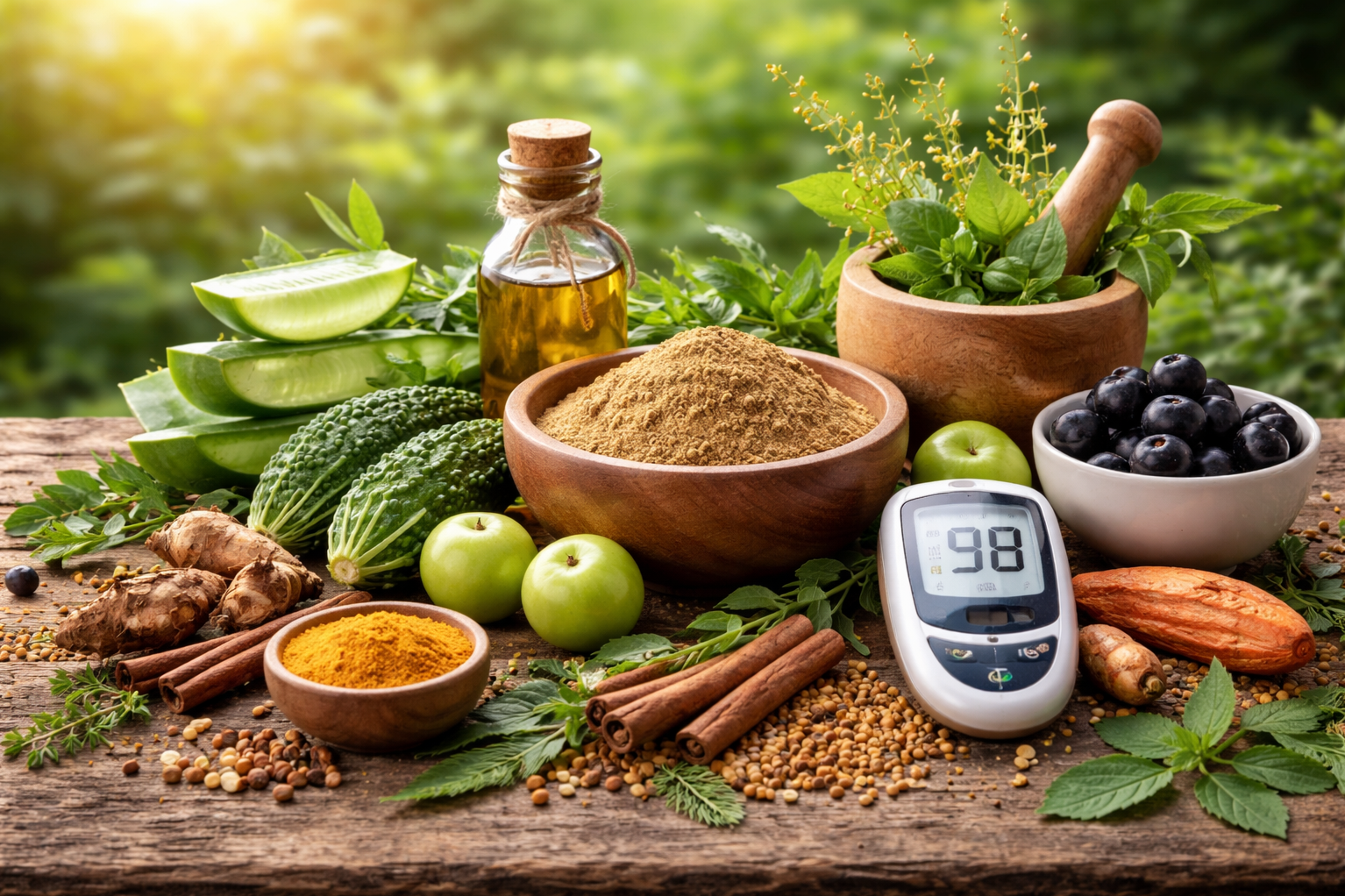
Core answer: Ayurvedic medicines may have a role as complementary care for some people, but current evidence does not establish Ayurvedic medicines as a reliable replacement for proven diabetes treatment. A few herbs and plant-derived preparations have shown possible glucose-lowering effects in small or variable studies, but the evidence is not strong or consistent enough to say that Ayurvedic medicines as a category can control diabetes on their own. The American Diabetes Association's 2026 Standards of Care specifically state that herbs and spices such as cinnamon and aloe vera are not recommended for glycaemic benefit
What does Ayurveda say about diabetes?
Ayurvedic literature discusses Prameha and Madhumeha, conditions that have been interpreted in relation to diabetes mellitus. The Ministry of Ayush's Standard Treatment Guidelines for metabolic disorders describes Prameha as a broad Ayurvedic disease category and Madhumeha as one of its forms. These are Ayurvedic diagnostic concepts and should not be treated as automatically identical to a modern diabetes diagnosis.
This distinction matters. Modern diabetes care uses measurable clinical criteria such as blood glucose and HbA1c, while Ayurveda uses its own framework of symptoms, examination and disease classification. A person should therefore not assume that feeling better or having fewer symptoms means blood glucose is controlled.
Bear & Blend clarity
Traditional use and clinical proof are not the same thing.
Ayurveda can be discussed respectfully as a traditional system of medicine, while the effectiveness of a particular treatment still needs to be judged by the quality, consistency and relevance of clinical evidence.
What does modern research say?
Research has investigated many herbs used in Indian traditional medicine, including fenugreek, bitter gourd, Gymnema, tulsi, jamun and others. Reviews have reported potentially glucose-lowering effects for some preparations, but studies vary substantially in the plant used, extraction method, dose, duration, patient population and study quality. An older systematic review of Ayurvedic herbs for diabetes concluded that the literature was heterogeneous and that several interventions needed further study.
More recent evidence summaries are cautious. The U.S. National Center for Complementary and Integrative Health (NCCIH) notes that some supplements—including cinnamon, chromium or berberine—may show possible benefits in some studies, but limitations and inconsistent results prevent firm conclusions for most supplements. It also states that there is not reliable evidence that herbal supplements as a group can control diabetes or its complications.
Evidence signal
Some herbs show promise
Individual plants have been studied for effects on fasting glucose, insulin sensitivity or HbA1c. A possible signal is not the same as proven clinical effectiveness.
Evidence limitation
Formulations are not interchangeable
A study of one standardized extract cannot automatically validate every powder, juice, tablet or multi-herb formulation sold under a similar name.
Clinical standard
Diabetes needs measurable control
Blood glucose and HbA1c remain central to assessing glycaemic control. Symptoms alone cannot reliably tell you whether diabetes is controlled.
What about herbs commonly discussed for diabetes?
Indian households commonly hear about ingredients such as methi (fenugreek), karela (bitter gourd), gurmar (Gymnema sylvestre), jamun, neem, tulsi and cinnamon. These have varying levels of traditional use and scientific research. Some studies suggest possible effects on blood glucose, but the strength of evidence differs and a kitchen ingredient is not automatically equivalent to a standardized medicinal preparation.
Traditional herbal use
Herbs such as fenugreek, bitter gourd and Gymnema are frequently discussed in Indian traditional medicine. Historical and laboratory evidence can be useful for research, but it does not by itself establish a treatment as effective for diabetes.
Why “natural” is not enough
The concentration of active compounds can vary between plants, preparations and batches. “Natural” also does not mean risk-free, interaction-free or suitable for every person with diabetes.
Important: This article intentionally does not provide doses or instructions for taking individual herbs as diabetes treatment. Dosing and formulation decisions should be made with a qualified healthcare professional who knows your diagnosis, medicines and kidney/liver health.
Why the answer is not simply “yes” or “no”
There are three different questions people often combine:
1. Can a herb change blood glucose?
Possibly. Some individual herbs have shown glucose-related effects in clinical studies. That does not establish a predictable or clinically meaningful effect for every person.
2. Can it treat diabetes?
Diabetes is a chronic metabolic disease with multiple risks and complications. Controlling it requires more than a single glucose reading and usually involves nutrition, activity, monitoring, and medicines when indicated.
3. Can it replace prescribed medicine?
There is not adequate evidence to recommend replacing proven diabetes medicines with Ayurvedic or herbal products. Doing so can allow hyperglycaemia to persist without obvious symptoms.
4. Can it be part of a broader plan?
Potentially, but only when the treating clinician knows about it and glucose monitoring continues. Complementary care should complement—not silently substitute for—effective diabetes management.
Are Ayurvedic medicines safe for people with diabetes?
Safety depends on the exact formulation, ingredients, dose, quality, the person's health conditions and other medicines. The idea that a product is safe simply because it is herbal is incorrect.
The Ministry of Ayush operates a pharmacovigilance programme for Ayurveda, Siddha, Unani and Homoeopathy medicines to monitor suspected adverse drug reactions and misleading advertisements. Its patient-safety guidance explicitly notes that “natural” does not automatically mean safe.
Hypoglycaemia risk
If a glucose-lowering herb or supplement adds to the effect of insulin or certain diabetes medicines, blood sugar may fall too low. The risk depends on the person's treatment and the substance involved.
Drug interactions
Herbal products can alter the effects or metabolism of medicines. A doctor or pharmacist should know about every supplement or traditional medicine being used.
Kidney & liver concerns
People with diabetes may already be at risk of kidney or other organ complications. Some supplements have been linked to organ injury, making unmonitored use particularly concerning.
Quality and authenticity
India has official pharmacopoeial standards for identity, purity and strength of Ayurvedic drugs, including limits for heavy/toxic metals, pesticide residues, aflatoxins and microbial contamination. Consumers should not assume that every online or informal product meets those standards.
What should Indian readers keep in mind?
Diabetes is common in India, and many people are familiar with Ayurveda, home remedies and traditional dietary practices. That cultural context is important, but it should not create a false choice between “natural” care and medical care.
For an Indian patient, a sensible approach is to discuss any Ayurvedic medicine openly with the clinician managing diabetes. Keep a record of the exact name, ingredients, manufacturer, dose and timing. Continue the recommended glucose monitoring and laboratory follow-up rather than judging success only by how you feel.
India-specific checklist
Before adding an Ayurvedic medicine, ask:
What exactly is in it? Is the formulation standardized? Could it interact with my diabetes medicines? Do I have kidney, liver, pregnancy or other health considerations? How will we monitor whether it is helping or causing harm?
How should diabetes control actually be monitored?
Good diabetes management is not based on one symptom, one fasting reading or one traditional remedy. Depending on the type of diabetes and the person's circumstances, clinicians may use HbA1c, fasting or post-meal glucose, home glucose monitoring or continuous glucose monitoring, blood pressure, cholesterol, kidney tests and screening for complications.
What you are monitoring
Blood glucose
HbA1c
Kidney health
Medicines & interactions
Why it matters
Shows current glucose levels and helps identify highs or lows.
Provides a longer-term picture of average glucose exposure.
Diabetes can affect the kidneys, and some supplements may also pose kidney risks.
Helps prevent adverse effects and treatment duplication.
What to avoid
Stopping treatment because one reading looks better.
Assuming one “normal” result means diabetes is permanently cured.
Using unmonitored herbal products when kidney disease is present.
Keeping supplements or Ayurvedic medicines hidden from the treating clinician.
Can Ayurveda be used alongside standard diabetes care?
For some people, an integrative approach may be possible. The key is coordination. A qualified Ayurvedic practitioner and the clinician managing diabetes should know what the other is recommending, particularly when medicines or concentrated herbal preparations are involved.
Evidence-based diabetes care also includes healthy eating, regular physical activity, weight management where appropriate, sleep, blood-pressure and lipid management, and screening for complications. The 2026 ADA Standards of Care advise against using herbs or spices specifically for a glycaemic benefit because evidence is insufficient.
Do not stop insulin or prescribed diabetes medicines on your own. If you believe an Ayurvedic approach is helping, discuss the glucose results with your treating clinician before changing any medication. Medication reduction, when appropriate, should be supervised and based on documented glycaemic control.
When should someone with diabetes seek urgent medical help?
Do not rely on an Ayurvedic or home remedy when a person is acutely unwell. Urgent medical assessment is appropriate for severe or persistent hypoglycaemia, confusion or loss of consciousness, repeated vomiting, severe dehydration, difficulty breathing, chest pain, or very high glucose accompanied by symptoms of possible diabetic ketoacidosis or hyperosmolar hyperglycaemic state.
If symptoms are severe, emergency medical care should take priority over trying a new herbal medicine.
Do Ayurvedic medicines really help control diabetes?
Some individual herbs and traditional formulations have shown possible glucose-lowering effects in studies, but the evidence is inconsistent and often limited. Current evidence does not support Ayurvedic medicines as a reliable replacement for proven diabetes treatment.
Can Ayurveda cure diabetes permanently?
There is no good evidence that Ayurvedic medicines permanently cure diabetes. Some people with type 2 diabetes can achieve remission through substantial lifestyle and/or medical interventions, but remission is different from a guaranteed cure and requires ongoing monitoring.
Can I stop my diabetes medicine if I start Ayurveda?
No. Do not stop insulin or prescribed diabetes medicines without medical supervision. If glucose control improves, medication changes should be discussed with the clinician managing your diabetes.
Is karela a diabetes treatment?
Bitter gourd has a long history of traditional use and has been studied for glucose effects. However, evidence is not strong enough to treat karela as a replacement for established diabetes therapy.
Can Ayurvedic medicine be taken with metformin or insulin?
Potential interactions are possible, and the answer depends on the exact Ayurvedic preparation and the person's health. The safest approach is to tell the prescribing clinician and pharmacist exactly what is being taken.