
Are Artificial Sweeteners Safe for Diabetics?
A practical, India-focused guide to sugar substitutes, blood glucose, stevia, sucralose, aspartame, food labels and what the evidence actually says.

Many approved non-sugar sweeteners can be used by people with diabetes, but “sugar-free” does not automatically mean “healthy.”
For blood-glucose control, the key is what the whole food or drink contains—not just whether it uses a sweetener. ICMR guidance notes that non-nutritive or hypocaloric sweeteners can replace caloric sweeteners, while the evidence for improving glycaemia, weight or cardiometabolic risk is limited.
If you have diabetes and want to reduce added sugar, a non-sugar sweetener may be a useful tool. But it should support an overall balanced eating pattern—not become a reason to eat more ultra-processed “sugar-free” foods.
What are artificial and non-sugar sweeteners?
Artificial sweetener” is a common consumer term, but it covers several different ingredients. The broader technical term is non-sugar sweeteners (NSS). These can be synthetic compounds such as aspartame, sucralose, saccharin and acesulfame-K, or naturally derived sweeteners such as steviol glycosides from the stevia plant.
They are intensely sweet, so only a small amount is needed. Some are virtually calorie-free at the quantities used in food. Others, such as certain sugar alcohols or products that combine sweeteners with carbohydrate fillers, behave differently and should not be treated as identical.
Non-sugar ≠ nutritious
Replacing sugar can reduce free-sugar intake, but a sugar-free biscuit, dessert or drink can still be highly processed or low in fibre and protein.
Look beyond the front label
“No added sugar” and “diabetic-friendly” are not enough. Check total carbohydrate, serving size and the ingredient list.
Do artificial sweeteners raise blood sugar?
Most high-intensity non-sugar sweeteners are used in very small quantities and generally do not contribute the same carbohydrate load as table sugar. This is why they can be useful when someone wants sweetness while reducing sugar intake.
However, the finished product matters. A “sugar-free” packaged food may contain flour, starch, milk solids, fruit concentrates or other carbohydrate-containing ingredients. Those ingredients can contribute to blood glucose even when sucrose is absent.
For this reason, people with diabetes should not assume that every product carrying a “sugar-free” claim is suitable in unlimited amounts.
Common sweeteners you may see in India
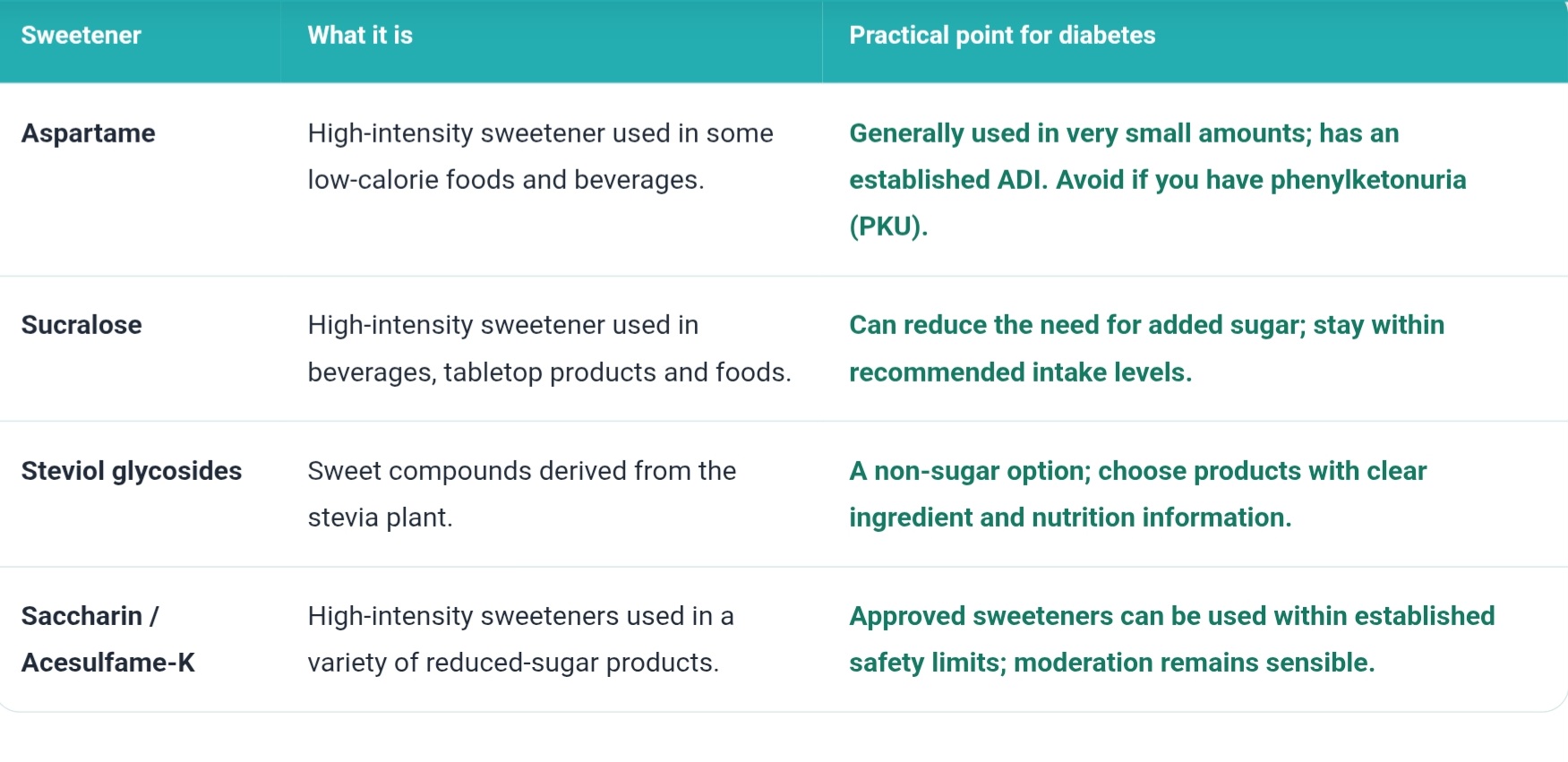
What do WHO and ICMR say?
There are two different questions here: Is a particular sweetener toxic at normal permitted intakes? and Does routinely consuming non-sugar sweeteners improve long-term health? The evidence and recommendations are not identical for these questions.
ICMR guidance lists commonly used non-nutritive and hypocaloric sweeteners—including aspartame, acesulfame-K, stevia and sucralose—and states that intake within acceptable daily intake (ADI) levels is considered safe. It also notes that the evidence for improving glycaemia, weight reduction or cardiometabolic risk is limited.
WHO's 2023 guideline on non-sugar sweeteners recommends against using NSS as a strategy for long-term weight control or reducing non-communicable disease risk in the general population. Importantly, WHO states that this recommendation does not apply to people with pre-existing diabetes. The guideline also says it is not a toxicological safety assessment of individual sweeteners and does not replace established ADIs
Important distinction: “WHO does not recommend NSS for weight control” is not the same as “WHO says artificial sweeteners are unsafe for people with diabetes.” For people with pre-existing diabetes, that particular WHO recommendation does not apply. Individual sweetener safety still depends on the ingredient, dose, product and personal circumstances.
What is an acceptable daily intake (ADI)?
ADI is an estimate of the amount of a food additive that can be consumed daily over a lifetime without appreciable health risk, based on the available safety assessment. It is expressed according to body weight.
For example, the FAO/WHO Joint Expert Committee on Food Additives (JECFA) currently lists an ADI of 0–40 mg/kg body weight/day for aspartame. JECFA lists 0–15 mg/kg/day for sucralose and 0–4 mg/kg/day for steviol glycosides, expressed as steviol.
How should a person with diabetes choose a “sugar-free” product?
The most useful habit is to read the nutrition panel rather than relying on the marketing claim on the front of the pack.
Check serving size. A small stated serving can make carbohydrate numbers look lower than the amount you actually eat.
Check total carbohydrate. “Sugar-free” does not mean carbohydrate-free.
Read the ingredient list. Look for the sweetener and other carbohydrate-containing ingredients.
Compare the whole product. Fibre, protein, saturated fat, sodium and calories also matter.
Avoid the “health halo.” Sugar-free cookies and desserts are still foods to portion sensibly.
Watch your own response. If you monitor glucose, compare readings according to the plan given by your healthcare professional.
Practical tips for Indian households
1. Start with the easiest sugar sources
For many Indian diets, added sugar can come from chai, coffee, sweetened milk drinks, mithai, biscuits, bakery foods and packaged beverages. Reducing the frequency and quantity of these foods can have a larger nutritional impact than obsessing over one sachet of sweetener.
2. Keep portions in mind
A non-sugar sweetener can make a food lower in sugar, but it does not automatically make a large portion appropriate. A sugar-free dessert can still provide substantial calories or carbohydrate from flour, starch, nuts, dairy or other ingredients.
3. Prefer naturally less-sweet habits over constant sweetness
WHO encourages reducing the overall preference for very sweet foods and drinks. This is a useful long-term goal even for someone who occasionally uses a non-sugar sweetener. citeturn0search9turn0search1
4. Do not change diabetes medicines because of a sweetener
Sweetener choice should not be used to adjust insulin, tablets or other diabetes medicines on your own. If your glucose readings change consistently after a dietary change, discuss the pattern with your doctor or diabetes educator.
So, are artificial sweeteners safe for diabetics?
For many people with diabetes, approved non-sugar sweeteners can be used in moderation and within established safety limits. They may help reduce added sugar and carbohydrate from sweetened foods and drinks, but they are not a treatment for diabetes and should not be viewed as a free pass to consume unlimited “sugar-free” products.
The most sensible approach is to choose foods based on their overall nutritional quality, keep portions appropriate, reduce the overall preference for very sweet foods, and use non-sugar sweeteners selectively when they help you replace added sugar.
Bear & Blend takeaway
Use sweeteners as a tool—not as a health claim.
If a sweetener helps you replace added sugar without leading to larger portions or more processed foods, it can have a practical role. But your diabetes-friendly diet should still be built around vegetables, pulses, whole or minimally processed foods, appropriate protein, fibre-rich carbohydrates and sensible portions.
Is stevia safe for diabetics?
Steviol glycosides are a type of non-sugar sweetener. JECFA's current ADI is 0–4 mg/kg body weight/day, expressed as steviol. For a person with diabetes, the practical issue is also what else is present in the stevia product—some tabletop blends contain other ingredients—so the label still matters.
Is sucralose better than sugar for diabetes?
Sucralose can be used to provide sweetness without the same amount of sugar. That can be useful when replacing added sugar, but “better” depends on the whole diet and product. ICMR notes that the evidence for long-term improvements in glycaemia, weight or cardiometabolic risk from non-nutritive sweeteners is limited.
Can diabetics drink sugar-free soft drinks?
A sugar-free soft drink may contain little or no sugar, but it should not replace water or become an everyday source of sweetness. Check the label and consider your overall dietary pattern. WHO's general guidance encourages reducing reliance on very sweet tastes over time.
Does “no added sugar” mean a food is safe for diabetes?
No. “No added sugar” describes added sugars, not necessarily total carbohydrate, calories or portion size. Always check the nutrition information and ingredient list.
Who should be extra careful?
People with specific medical conditions, allergies or medication-related dietary restrictions should discuss sweetener use with their clinician. Aspartame, for example, is not appropriate for people with phenylketonuria because it contains phenylalanine. Pregnant individuals should also discuss dietary sweetener choices with their healthcare professional rather than assuming that every product is appropriate.